 Staff Reporter: Various development organizations, civil society organizations (CSOs), media representatives, and other relevant stakeholders are emphasizing the need to increase the budget allocation for local government, Water-Sanitation (WASH) and social safety net sectors in the context of the upcoming National Budget for the fiscal year 2025-26.
Stakeholders engaged in these sectors are actively participating in pre-budget discussions and sharing their valuable insights and recommendations.
While no reform commission has been formed for the climate change sector, experts point out that WASH managed by local government suffers the most due to the impacts of climate change. For this reason, stakeholders are urging members of the Local Government Reform Commission to ensure sufficient budget allocation in this area.
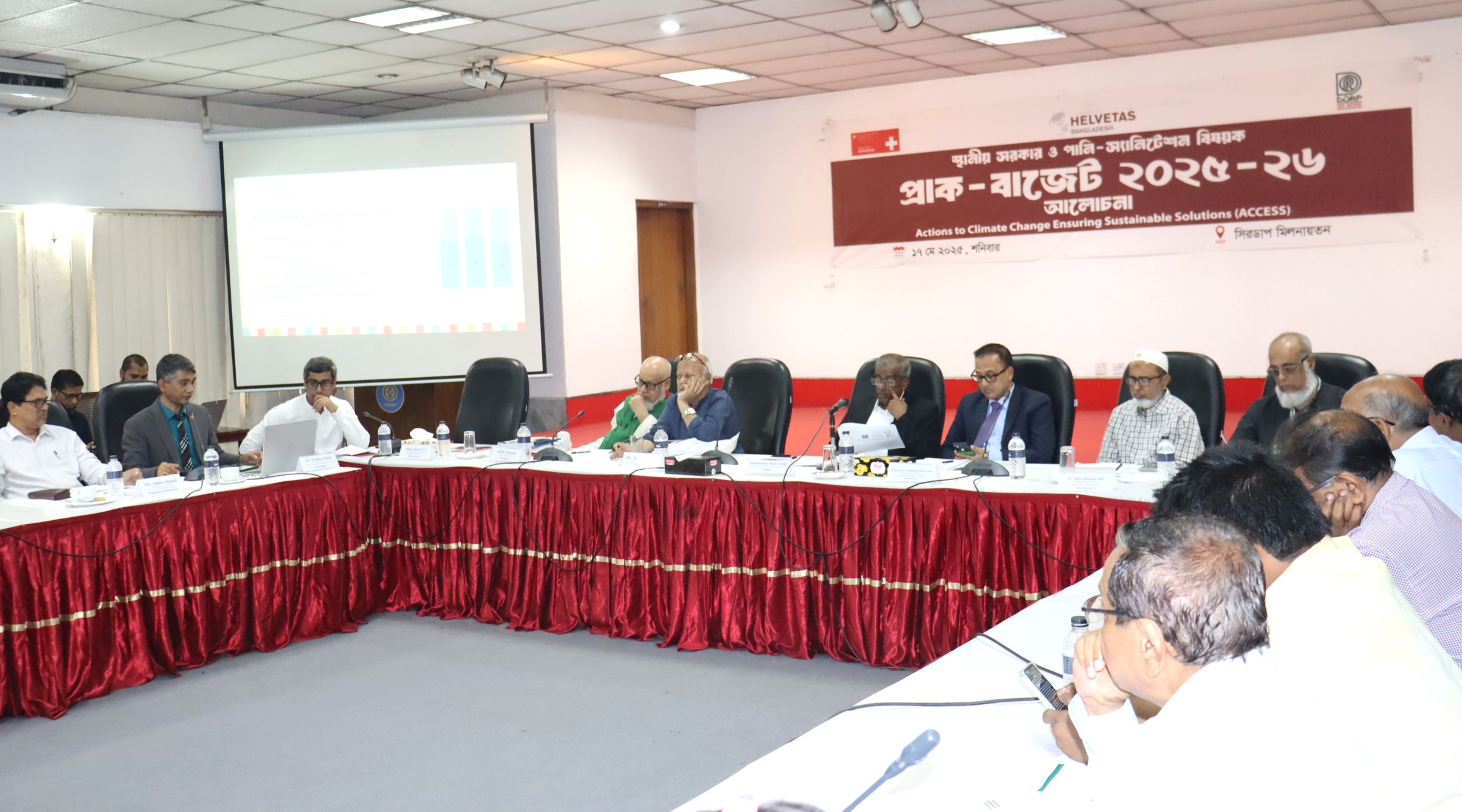
As part of this advocacy, development organization DORP, with support from Helvetas Bangladesh, organized a pre-budget discussion titled “Local Government and Water-Sanitation: Pre-Budget Dialogue 2025–26” under the Actions to Climate Change Ensuring Sustainable Solutions (ACCESS) project.
The event was held on Saturday, 17 May, at the CIRDAP Auditorium in Dhaka. One of the key demands raised during the dialogue was to treat WASH as a standalone budget sector rather than as a project-based component, to promote sustainable development outcomes.
Experts at the event noted that WASH programs typically become stagnant once a project ends, and remain inactive until new projects are initiated, resulting in negative consequences. If WASH initiatives were treated as a continuous budget sector, it would be possible to maintain consistency, which, in turn, would yield significantly better outcomes when considered as an investment.
The discussion was chaired by Mohammad Nurul Amin, Chairman of DORP and Global Islami Bank, and moderated by Mohammad Zobair Hasan. Notable speakers included Dr. Tofail Ahmed, Chairman of the Local Government Reform Commission; Dr. Mohammad Helal Uddin, Executive Vice Chairman of the Microcredit Regulatory Authority; Sabbir Ahmed, Member of the Bank Reform Task Force; Dr. Zillur Rahman, Managing Director of the Bangladesh NGO Foundation; Munshi Alauddin Al Azad, former Joint Secretary; Mir Abdus Sahid, Addl. Chief Engineer (Works) and Eheteshamul Russel Khan, Addl. Chief Engineer (Planning) from the Department of Public Health Engineering (DPHE); and Mainul Hasan Sohel, General Secretary of Dhaka Reporters Unity.
Presentation papers were delivered by A.H.M. Noman, Founder and CEO of DORP, and Dr. Mahfuz Kabir, Research Director of the Bangladesh Institute of International and Strategic Studies (BIISS). Dr. Abu Mohammad Zakir Hossain was present as a special guest.
In his presentation, Dr. Mahfuz Kabir pointed out that in the proposed 2025–26 fiscal year, the per capita budget for the local government sector may be as low as BDT 466, which is grossly inadequate.
Highlighting the importance of treating WASH as a separate budget sector, Dr. Tofail Ahmed noted that while the ministry prepares the budget, allocations are made project-wise. Therefore, when a project ends, its budget allocation also ends. He emphasized the need to think beyond projects and advocated for direct sectoral allocations. He further noted that although the budget technically reaches Union Parishads, it is insufficient.
Moreover, there’s a lack of transparency about how much budget each district receives and spends, which must be addressed. He proposed the idea of district-level budgeting with citizen participation.
In his speech, Dr. Helal Uddin, who oversees 776 development organizations under the Microcredit Regulatory Authority, said: “Our collected taxes are used in operational expenses, while development activities are funded mostly through loans. To ensure the effective use of the budget, decentralization is a must.”
Mohammad Mahmodul Hasan, Head of Program- Water, Food and Climate at HELVETAS Bangladesh, proposed the creation of a “Water Calendar” to track water scarcity trends across regions. This would help authorities take timely and effective action and incorporate the data into annual plans and the national budget.
Dr. Zillur Rahman emphasized the need for capacity building and proper utilization of allocated budgets. He added that implementers must be confident and empowered to make full use of allocated resources. “We must ensure that the budget is allocated where it’s needed most, and implemented accordingly. Increased health sector spending will always yield positive outcomes,” he said.
Sabbir Ahmed noted that although the government has the intention to improve the sector, it lacks sufficient resources. A large portion of the national budget is now spent on repaying domestic and international loans. He strongly advocated for budgeting WASH as a sector with a specific budget code rather than on a project-by-project basis, which would allow for real progress.
Md. Shariar Mannan, Domain Coordinator-Voice, Inclusion & Cohesion and Project Manager-EVOLVE at HELVETAS Bangladesh, shared that they organize open budget sessions in various unions of Khulna and Bagerhat districts to promote participatory budgeting and increase public awareness.
In his concluding remarks, Nurul Amin, Chairman of DORP, stated, “The third world war will be fought over water whether we understand it or not. In a way, we are already fighting that war. Ensuring education, health, and good governance is critical. We must realize that we are not progressing; we are merely growing.”
Munshi Alauddin Azad emphasized the deep connection between sanitation and health. “Without life, nothing matters. Therefore, WASH deserves special importance in national development,” he said.
Ehteshamul Russel echoed the sentiment that government allocations are mostly project-based. “If WASH isn’t recognized as a dedicated budget sector, allocations will always be inconsistent. Most current projects are nearing completion, and unless new projects are taken up, there will be no increased funding in this sector.”
Mir Shahid highlighted that water supply is provided under 48 projects across rural and urban areas of the country, but delivering water to hilly, haor, and coastal areas remains a significant challenge.
Other speakers included Saiful Islam Moazzem, General Secretary of the Bangladesh Union Sodosso Sonstha (BAISOS), who emphasized the need to strengthen Union Parishads; Sufia Begum, a representative from the southwestern region, who demanded compensation for the damages caused by climate change; Mohammad Shamsuddoha, Chief Executive of CPRD; Rabeya Begum, Executive Director of SDS; Sanjida Jahan Ashrafi from DSK; and Iqbal Azad from Max Foundation, among others.