United news 24 Desk ::
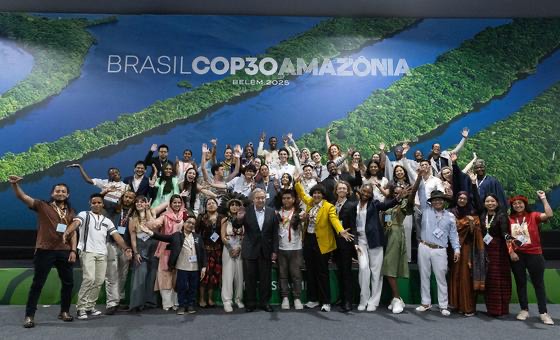
United Nations Secretary General António Guterres has issued one of his strongest warnings yet that the world is entering a decisive battle to end the fossil fuel era, telling young people at UN Climate Summit (COP30) that their leadership is critical as governments continue to fall short.
As COP30 enters a critical phase, the message from Belém is clear. The drive to end the fossil fuel era has begun in earnest and young people, Indigenous peoples and frontline communities insist that the transition must be just, inclusive and rooted in rights.
On Tuesday, Speaking at a youth roundtable in Belém, the UN secretary general said the planet is now on track to breach the 1.5C threshold and the priority must be to ensure the overshoot is as short as possible. He accused powerful interests of obstructing progress and placing profit above people and the planet, urging young people to sustain pressure on negotiators.
“We are in a decisive battle to phase out fossil fuels,” he said. “Youth leadership is not optional, it is indispensable.”
Sixteen-year-old Brazilian delegate João Victor da Silva voiced the growing frustration among young people. “We don’t want to be activists. We just want to be children,” he said. “But adults are not making the right decisions.”
From Aruba, youth delegate Nigel Maduro warned that slow negotiations were devastating for island nations. “The beaches of my childhood are disappearing,” he said. “Negotiations are moving too slowly for islands like mine.”
Guterres acknowledged these concerns and said both youth and Indigenous leadership must feature more prominently across the UN climate process. He pledged to push for more direct and less bureaucratic financing for Indigenous peoples, describing their knowledge as essential for safeguarding ecosystems under threat.
Global ministers back Brazil’s effort to strengthen fossil fuel language
In ongoing consultations, ministers from Colombia, Germany, Kenya, the Marshall Islands, Sierra Leone and the United Kingdom expressed strong support for Brazil’s effort to reinforce language on fossil fuel transition in the negotiating text expected later this week. The coalition wants a clearer commitment to phasing out fossil fuels in line with the 1.5C temperature limit.
A moment of quiet spread across the room when COP30 youth champion Marcele Oliveira spoke. “Fossil fuels are destroying dreams,” she said. “The transition away from them is the most important climate justice mobilisation of our generation.”
Oliveira referenced the recent International Court of Justice advisory opinion calling government inaction on climate change an environmental crime, saying it should trigger stronger accountability. “We must move away from fossil fuels, protect forests and protect those who protect them,” she said. “A just transition listens to, welcomes and respects the territories.”
Bangladesh: ‘A transition that ignores inequality is no transition at all’
Bangladesh’s youth delegate Sohanur Rahman, Executive Coordinator of YouthNet Global, said global climate solutions must be grounded in justice if they are to succeed. “A transition that does not address inequality is not a transition,” he said. “A truly just transition must protect workers, frontline communities, Indigenous peoples and young people. We cannot replace one system of exploitation with another. Climate solutions must be fair, inclusive and accountable.”
Rahman warned that failing to integrate equity into the fossil fuel phaseout risked deepening existing injustices and undermining public trust.
Gender justice: calling out patriarchal masculinities in climate policy
On the gender agenda, Bangladeshi feminist climate advocate Saila Sabanam Richi, an observer with the MenEngage Alliance, said the UNFCCC Gender Work Programme must address deeper structural barriers. “We cannot talk about climate justice without addressing patriarchal masculinities,” she said. “The Gender Work Programme must mandate initiatives engaging men and boys including male leaders to challenge harmful gender norms and promote shared responsibility and accountability in climate action.”
 She said without confronting these norms, gender responsive policies risk remaining symbolic rather than transformative.
Indigenous leaders warn of an Amazon tipping point
Indigenous activist Txai Suruí described the youth roundtable as one of the most hopeful moments of COP30 but cautioned that the Amazon rainforest is dangerously close to a tipping point. “Some countries may not like the protests,” she said, referring to the demonstrations across Belém, “but Brazil is a democratic country. Protests ensure leaders make decisions in favour of life.”
Suruí warned that corporate lobby groups remain larger than all national delegations combined, vastly overshadowing Indigenous voices at a time when the forest is nearing collapse.