United news 24 Desk ::
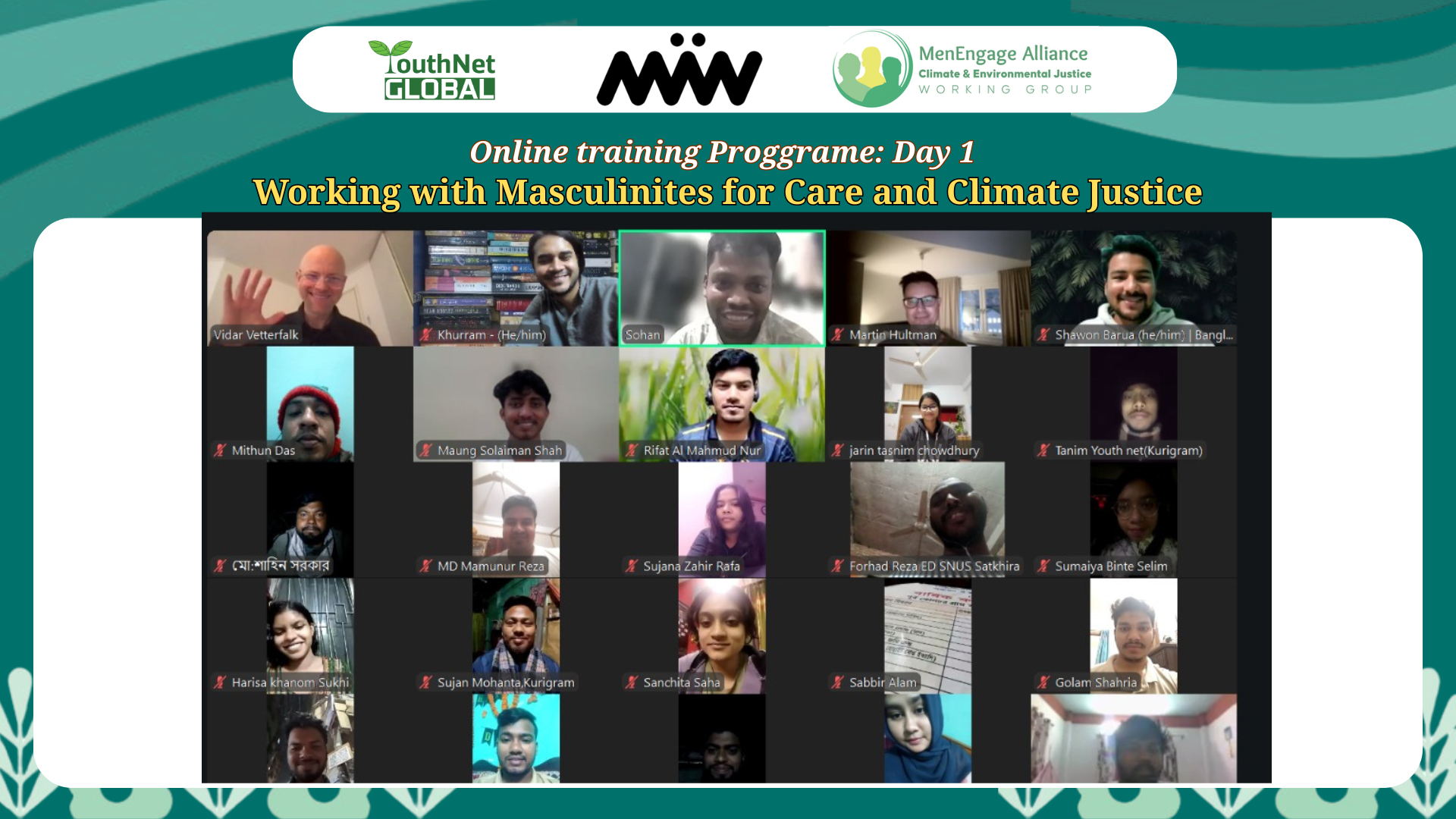
A three-day online training under the EcoMen initiative commenced, bringing together nearly fifty participants from different parts of Bangladesh in an interactive learning platform. The training is jointly organised by YouthNet Global and the Sweden-based development organisation MÄN, with support from the Environment and Climate Justice Working Group of the MenEngage Alliance.
Opening session on Tuesday was co-facilitated by Sohanur Rahman, executive coordinator of YouthNet Global, alongside supporting trainer Vidar Vetterfalk, a psychologist and international project manager at MÄN. The keynote speaker of the day was Professor Martin Hultman from the Department of Sociology and Work Science at the University of Gothenburg, Sweden.
An internationally recognised sociologist and researcher, Professor Hultman is actively engaged in education and policy dialogues. His work bridges academic knowledge with social movements and real-world change, contributing significantly to climate justice and broader social transformation, organisers added.
EcoMen is a pioneering initiative that engages men and boys in climate action and environmental stewardship while challenging harmful patriarchal norms. The initiative aims to foster care, responsibility, and gender-transformative approaches to building sustainable communities, highlighting the role of men as allies in advancing climate justice, organisers said.Speaking about the training, Sohanur Rahman said, “EcoMen empowers men and boys to rethink their roles in society and take responsibility for climate justice. By connecting gender equity with environmental stewardship, we hope to create a culture of care and accountability that drives real change in our communities.”
The training aims to deepen participants’ understanding of masculinities and patriarchal harmful norms, and how these intersect with gender inequality, social injustice and the climate crisis. It also focuses on building practical skills for engaging boys and men as allies, fostering care, accountability and transformative action in both local and global contexts. Another key objective is to cultivate reflective, participatory and visionary capacities that enable participants to imagine and contribute to a post-patriarchal, just and sustainable world.
By the end of the programme, participants are expected to be able to analyse different forms of masculinities, recognise patriarchal harmful norms and understand their social, environmental and gendered impacts. They are also expected to demonstrate practical strategies for engaging boys and men as allies and agents of change, promoting care, justice and accountability within climate action initiatives. Participants should be able to envision and articulate personal and collective actions using participatory and reflective approaches in their own contexts, organisers said.
During the session, Vidar Vetterfalk explained a series of visuals and conceptual models illustrating the links between masculinities and the climate crisis. These included industrial or breadwinner masculinity, described as a “black fossil ego” rooted in extraction, separation and domination; ecomodern masculinity, referred to as a “greenwashed ego” reliant on technocratic fixes, false efficiency and narratives of green growth without systemic change; and ecological masculinity, framed as an eco perspective beyond binaries, emphasising interdependence, humility, care, reciprocity, justice, equality and interconnectedness.
The EcoMen online training will continue for the next two days, providing participants with opportunities to engage further with these concepts, discuss local and global strategies, and develop actionable plans to promote care-based masculinities and gender-transformative climate action within their communities.
Sharing examples from his research, Professor Hultman discussed the root causes of the climate crisis, pointing to climate denial, the fossil fuel industry, the rise of far-right politics and their intersections with dominant forms of masculinity. He contrasted care-based worldviews with control-based worldviews, highlighting how deeply gendered power structures continue to create barriers to ecological and just transitions at both local and global levels.
Professor Hultman also emphasised the importance of recognising the rights of nature and adopting gender-transformative approaches as critical pathways to advancing climate justice and building sustainable societies. His insights encouraged participants to see the connection between social justice, gender equality, and environmental stewardship as inseparable elements of sustainable development.