United news 24 Desk ::
Rising seas, salinity intrusion, extreme heat, and erratic rainfall are already reshaping lives and livelihoods across Bangladesh. Research projects that one in seven Bangladeshis could face displacement in the coming decades, underscoring the urgency of embedding social protection, labour rights, and community resilience at the heart of climate planning and financing.
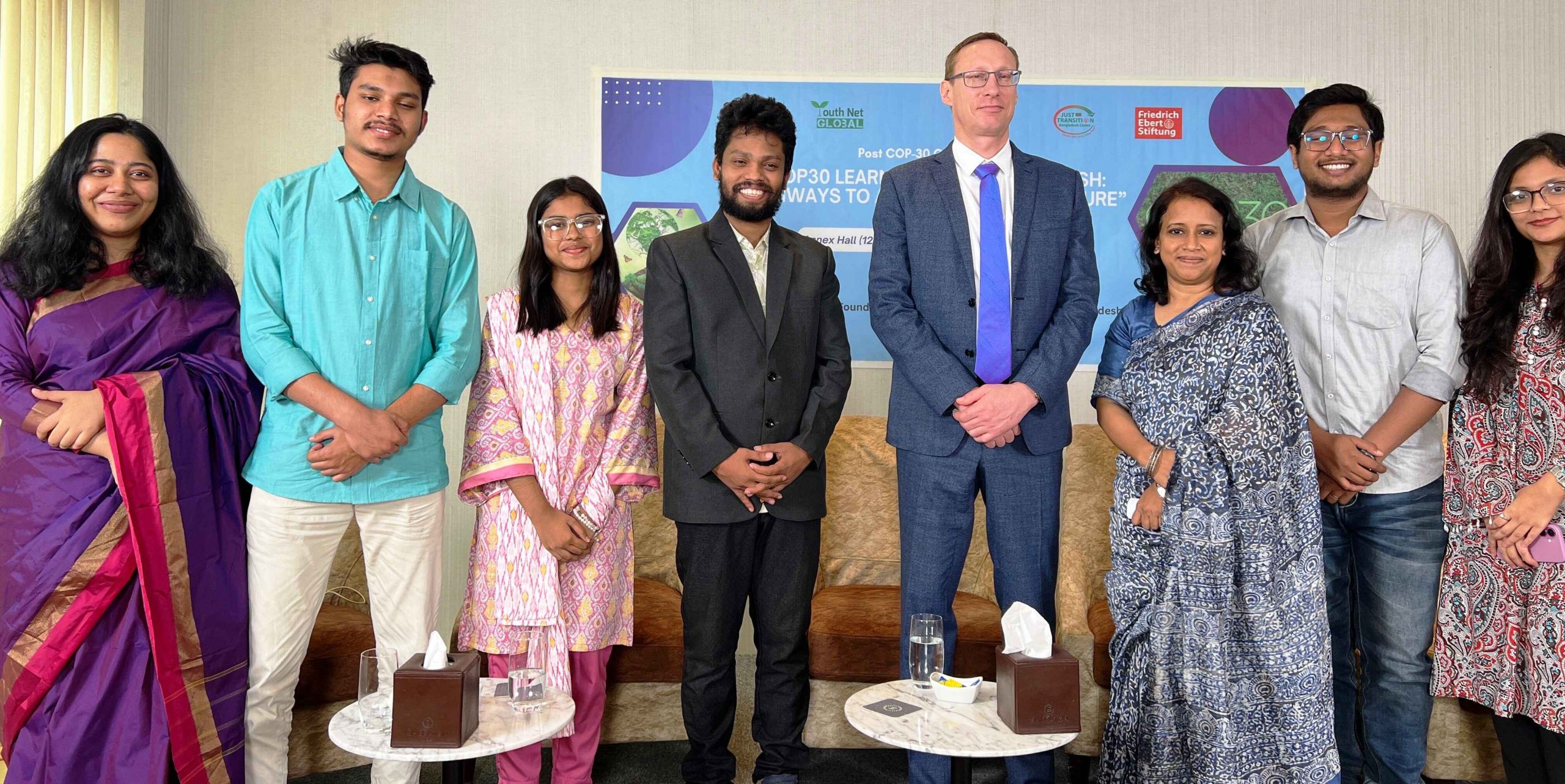
In a high-level national consultation titled *“COP30 Learnings for Bangladesh: Pathways to a Just & Resilient Future”, policymakers, climate experts, labour leaders, and youth representatives gathered to outline how Bangladesh can transform the outcomes of COP30 into a fair and inclusive climate transition. The event was organised by the Just Transition Bangladesh Coalition (JTBC), OSHE Foundation, Friedrich Ebert Stiftung (FES) Bangladesh, and YouthNet Global.
The consultation showcased Bangladesh’s leadership in embedding social justice into climate action, setting a precedent for the region, and reinforcing the nation’s commitment to a sustainable, equitable, and resilient future.
Opening the dialogue, Dr. Felix Gerdes, Resident Representative of FES Bangladesh, emphasised the importance of translating global climate commitments into actionable national strategies. “A Just Transition is essential to ensure that climate action uplifts the communities most exposed to climate risks,” he said, noting that climate policies must be people-centred to be truly effective.
Delivering the keynote, Dr. Fazle Rabbi Sadeque Ahmed, Deputy Managing Director of PKSF, reflected on Bangladesh’s historic achievement at COP30 in Belém, where the country became the first in Asia to place Just Transition at the heart of its NDC 3.0. He highlighted the challenges in accessing climate finance, noting that Bangladesh had missed two opportunities due to internal bottlenecks. “We must improve coordination and readiness to mobilise funds effectively. Developed countries must also take genuine domestic mitigation action, given their historical responsibility,” he said.
Speakers further raised concerns about the tight timeline for Global Stocktake (GST)-2, warning that the next IPCC report may arrive too late to guide NDC3 and financing cycles. Several participants expressed worry over attempts to dilute the centrality of the 1.5°C goal and weaken language on fossil fuel phaseout. Despite challenges in multilateral platforms, participants agreed that global cooperation remains crucial for vulnerable countries.
Chief guest Mohammad Navid Safiullah, Additional Secretary of the Ministry of Environment, Forest and Climate Change, reaffirmed the government’s commitment to a Just Transition. He highlighted that the concept, rooted in global labour movements, has evolved into a core pillar of climate justice, linking low-carbon development with decent work, social protection, and fairness.
He warned that climate impacts are already causing substantial losses in agriculture, fisheries, transport, and informal sectors. “A Just Transition provides a fair and inclusive pathway as we move toward a low-carbon, climate-resilient economy,” Safiullah said. He stressed the need to tackle barriers, prepare young people for the transition, and create pathways for their inclusion in emerging labour markets. “We urge all stakeholders to make stronger commitments for a just transition to renewables, protect workers’ rights, and ensure decent work.”
Safiullah also highlighted the Belém Action Mechanism as a global framework supporting equitable benefits from clean energy transitions. On the national front, the government is mapping priority sectors including energy, agriculture, textiles, and transport. A multi-stakeholder taskforce, involving youth groups, women’s organisations, research institutions, workers, and the private sector, is guiding the preparation of Bangladesh’s first National Just Transition Roadmap, scheduled for 2026. He called for predictable financing to support skills training, green jobs, and climate-affected communities.
The consultation featured a panel discussion moderated by Dr. S M Morshed, Vice Chair of OSHE Foundation, bringing together experts from academia, civil society, youth networks, and the media. Panelists included Dr. S.M. Munjurul Hannan Khan, Executive Director of NACOM; Arifa As Alam, Programme Adviser at FES Bangladesh; A.R. Chowdhury Repon, Chairperson of JTBC and Executive Director of OSHE Foundation; Sohanur Rahman, Executive Coordinator of YouthNet Global; and Shamsuddin Illius, Editor of The Climate Watch.
Panelists stressed youth engagement, labour rights, transparency, and community participation as the foundations of a Just Transition. Speaking during the session, Sohanur Rahman highlighted the critical role of young people in shaping climate solutions. “A Just Transition cannot succeed if youth voices are on the sidelines. Our role is to ensure the transition is not only green, but fair, inclusive, and grounded in community realities,” he said.
He emphasised that preparing young people for emerging green industries and creating opportunities in labour markets is essential for sustainable development.
Shamsuddin Illius underscored the importance of transparent climate financing and strong accountability mechanisms. “People on the frontlines deserve to know how climate funds are being used and who benefits. ” He added, “A just and resilient future will require strong policies, clear reporting, community participation, and responsible journalism.”
Other panelists highlighted the need to integrate labour rights, social protection, and community resilience into climate strategies, alongside expanding skills training and employment opportunities in the growing green economy.
During the open discussion, participants reaffirmed the importance of inclusive policymaking, long-term planning, and sustainable financing to support workers, women, youth, and vulnerable groups. They called for removing systemic barriers, ensuring equitable access to resources, and creating mechanisms to involve communities in decision-making processes. Panelists also stressed that the country must maintain momentum in implementing COP30 commitments while balancing global guidance with national priorities.
The consultation concluded with a summary of key recommendations and a collective commitment to ensure Bangladesh’s green transformation leaves no one behind. As the country moves toward finalising its National Just Transition Roadmap, the event highlighted growing national resolve to build a climate-resilient future centred on people’s wellbeing.